Electroencephalogram (EEG): an amplified recording of the waves of electrical activity that sweep across the brain’s surface; measured by electrodes placed on the scalp
CT scan (CAT scan): series of x-ray photographs taken from different angles and combined by computer into a composite representation of a slice through the body
PET scan (positron emission tomography): visual display of brain activity that detects where a radioactive form of glucose goes while the brain performs a given task; shows us what parts of the brain work when we perform different mental tasks
MRI (magnetic resonance imaging): uses magnetic fields and radio waves to produce computer-generated images that distinguish among different types of soft tissue; allows us to see the structure of the brain
fMRI (functional MRI): tracks blood flow from multiple MRIs taken in succession in order to indicate brain activity; allows us to see structures and function
Lower Brain
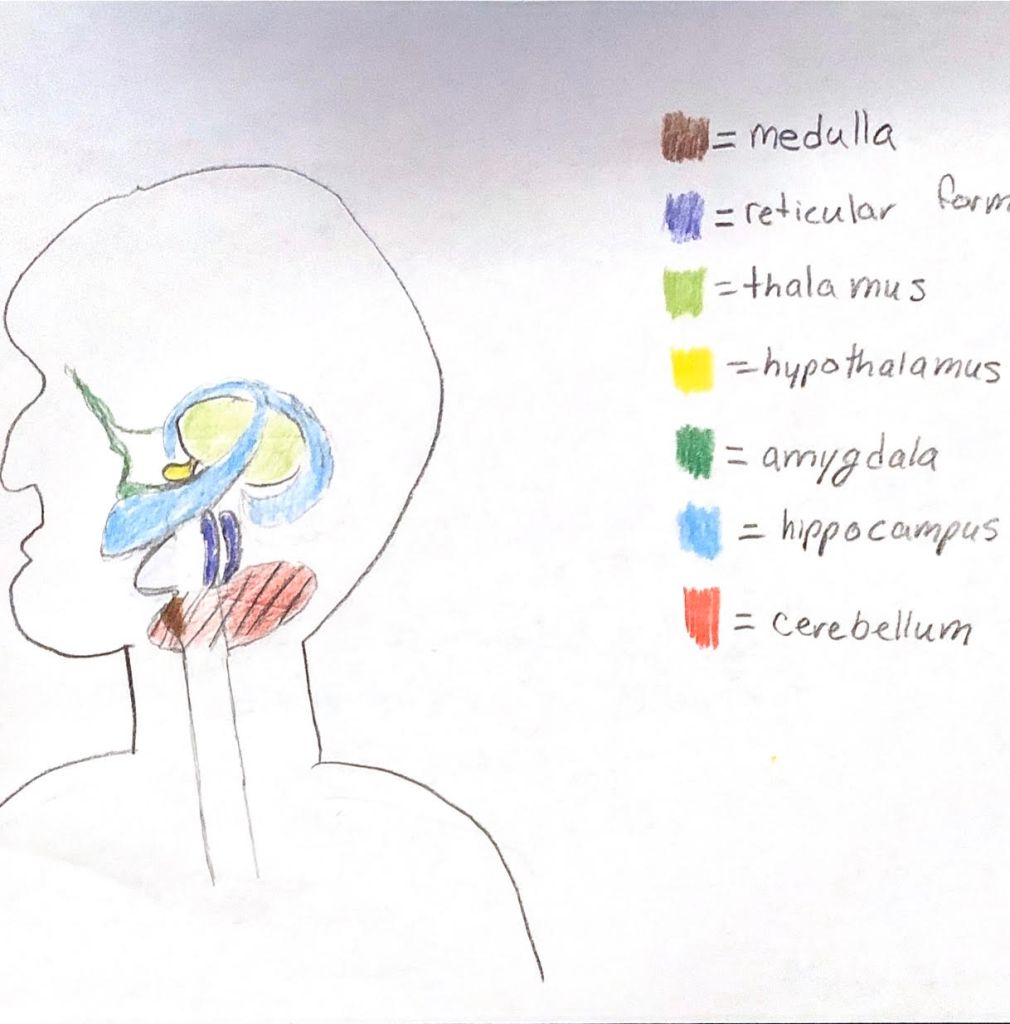
Brain stem: oldest part and central core of the brain; begins where the spinal cord swells as it enters the skull; responsible for automatic survival functions; cross over point where most nerves to and from each side of the brain connect with the body’s opposite side
Medulla: base of the brain stem; controls heartbeat and breathing
Reticular Activating system: nerve network in the brain stem that plays an important role in controlling arousal; filters incoming stimuli and relays important information to other areas of the brain
Thalamus: sensory switchboard; located on the top of the brain stem; directs messages to the sensory receiving areas in the cortex
Cerebellum: “little brain;” helps coordinate voluntary movement and balance; involved in learning behaviors and memory of that learning
The diagram above shows the different structures in the lower brain.
Mid-brain
Limbic system: doughnut-shaped system of neural structures at the border of the brain stem and cerebral hemispheres
Amygdala: almond-shaped structures linked to emotions such as aggression and fear
Hypothalamus: neural structure lying below the thalamus; directs basic needs for survival (eating, drinking, body temperatures); linked to emotion (fear, aggression) and triggers autonomic nervous system activity
Hippocampus: linked to memory
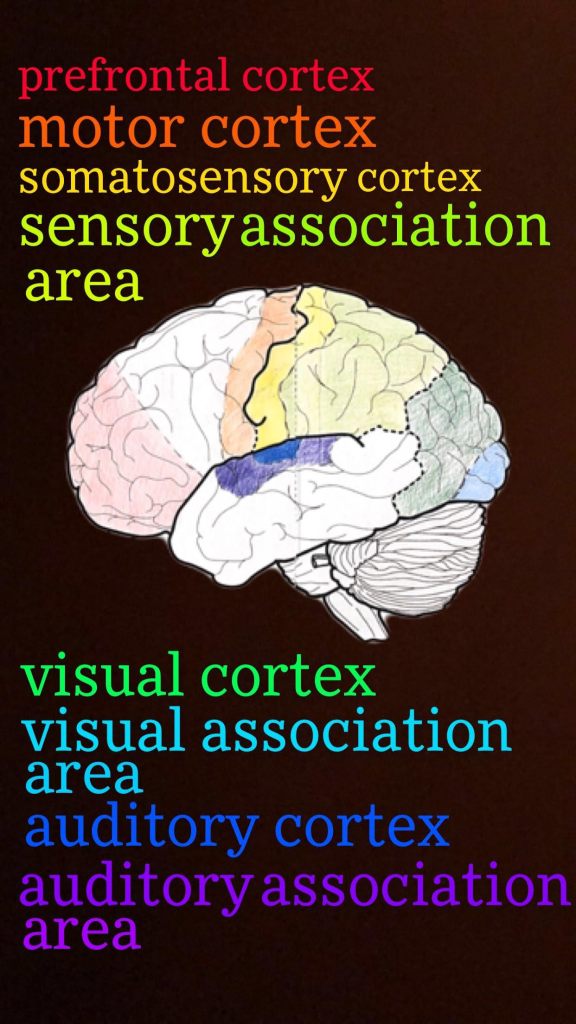
Cerebral Cortex: intricate fabric of interconnected neural cells that covers the cerebral hemispheres
Frontal lobes: portion of the cerebral cortex lying just behind the forehead; functions – speaking, muscle movement, higher-order thinking (planning, judgement), personality; motor cortex – controls voluntary movements
Parietal lobes: portion of the cerebral lying at the top of the head and toward the rear; functions – process sensory information; somatosensory cortex – processes body touch and movement sensations
Occipital lobes: portion of the cerebral cortex lying at the back of the head; function – vision
Temporal lobes: portion of the cerebral cortex lying roughly above the ears; functions – audition (hearing) and language comprehension
Nervous system: electro-chemical communication of the body; made up of nerve cells (neurons) divided into 2 systems
Central Nervous System (CNS): the brain and spinal cord
Peripheral Nervous System: neurons that connect the CNS to the rest of the body
Reflex: a simple, automatic, inborn response to a sensory stimulus
Types of Neurons
Sensory neurons: carry incoming info from the sense receptors to the CNS (body to brain)
Inter-neurons: CNS neurons that internally communicate within the brain and spinal cord
Motor neurons: carry outgoing info from the CNS to muscles and glands (brain to body)
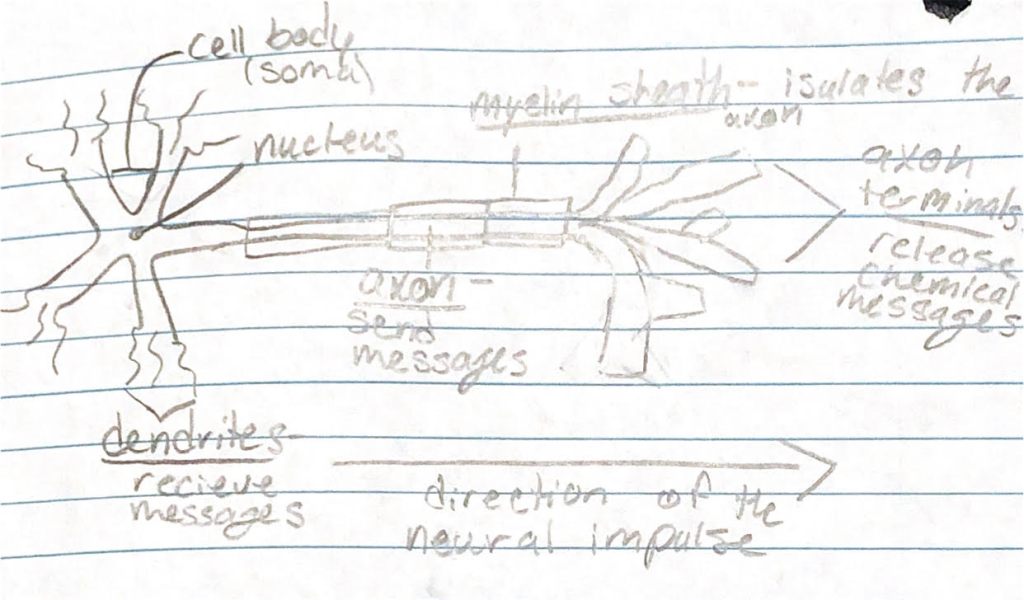
Neuron: a nerve cell; building block of the nervous system
The drawing above is of a neuron. All of the parts are labeled with definitions.
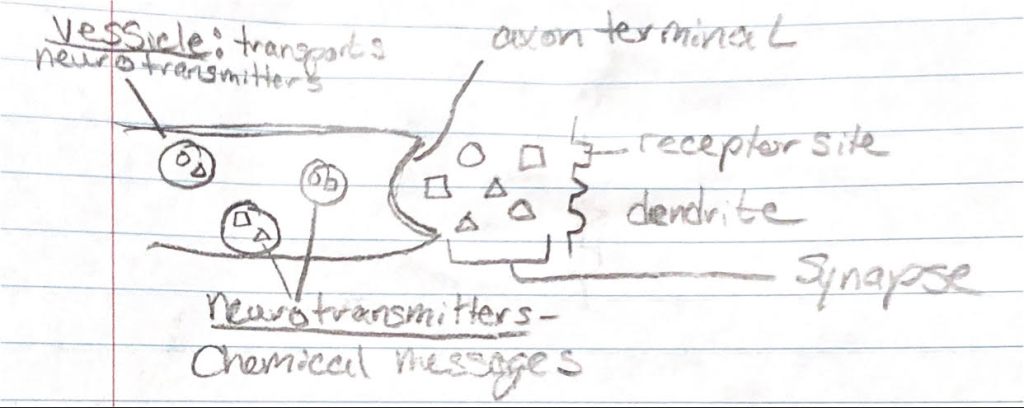
The drawing above is of a neuron’s receptor sites and synapse.
Action potential: a brief electrical charge that moves down an axon (all or none response)
Threshold: level of stimulation required to trigger a neural impulse
Synapse: space between the axon of one neuron and dendrites of another; often called the synaptic gap (less than one millionth of an inch!)
Re-uptake: neurotransmitters return to sending neurons
Neural networks: clusters of neurons that work together; each neuron connects with roughly 10,000 others
Neurotransmitters
Acetylcholine: triggers muscle contractions; involved in learning and memory (linked with Alzheimer’s)
Endorphins: natural, opiate-like neurotransmitters; linked to pain control and pleasure
Dopamine: influences movement, attention and emotion; linked to Parkinson’s Disease (not enough dopamine) and schizophrenia (overly active dopamine neurotransmitters)
Serotonin: affects mood, hunger, sleep and alertness
Agonist: mimics neurotransmitters and fills endorphin receptor sites and sends the message (like opiods)
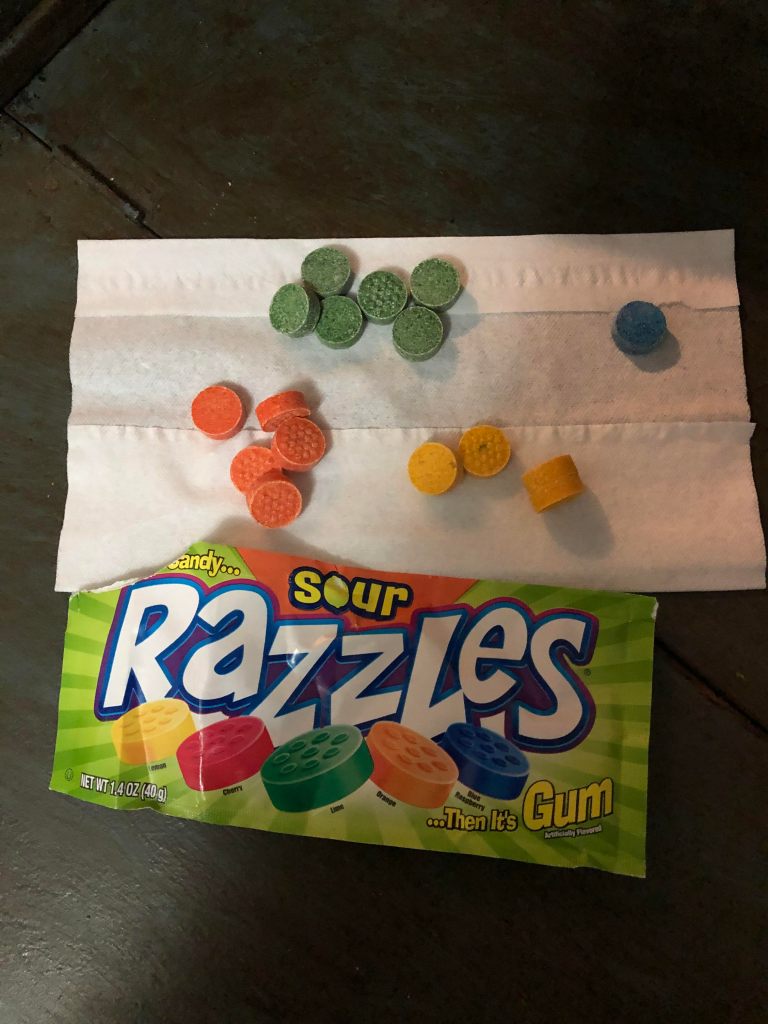
A fun activity to demonstrate random sample and population would be to open several bags of colored candies. In my psychology class, we did this with m and m’s and the population (N) would be each color that everyone has, while the random sample (n) would be just what came out of one single package. It is a very fun activity, plus we got to eat the candy afterwards. Just be sure to put the candy on a tissue or napkin rather than a dirty desk!
The picture above shows a random sample of a bagged candy.
Since psychology is a science, many psychologists have to research and do experiments. Listed below is information on the research methods that psychologists have to use!
Scientific Method
Develop a question and a theory — a theory is an explanation using an integrated set of principles that organizes observations and predicts behaviors or events
Create a hypothesis — a hypothesis is a testable explanation of a relationship between two things (often stated as a prediction like “if… then…”)
Test hypotheses through experiment or study
Analyze the results
Draw conclusions
Replicate the experiment or study to get the same results — use different participants and situations to allow researchers to see if basic findings continue to apply
Research Participants (Subjects)
Population: all members of a group being studied (N)
Sample: smaller group from the population who actually participate (n)
needs to be representative to generalize results
needs to be chosen RANDOMLY to minimize bias
Descriptive Research Methods
Case Study: in-depth investigation of individuals through observation and interviews. Not used for diagnoses but used to help people open up
advantage: get a lot of info about one person
disadvantage: can’t generalize results to the population, subjects could lie, and there could be interviewer bias
2. Studying change over time
Longitudinal Study: follow the same group of subjects for a length of time
advantage: clearly see a change over time
disadvantage: takes a lot of time and money, you can lose participants
Cross-Sectional Study: study differences in people across a certain age range at the same time
advantage: quick way to see change over time
disadvantage: comparing apples to oranges
3. Naturalistic Observation: observing and recording behavior in naturally occurring situations without manipulating or controlling the environment
advantage: participant behavior is honest
disadvantage: not in control and can’t determine why behaviors occur
4. Laboratory Observations: observing and recording behavior in a controlled setting
advantage: researchers have control over many aspects
disadvantage: participants might act differently because of the setting
5. Surveys: gather self-reported attitudes or behaviors of a particular group
advantages: information from a large group in a short period of time, easy to administer
disadvantages: easy for subjects to lie, non responsive, must be very carefully worded
Correlation: 1. How much does a change in A predict a change in B? 2. Reveals a relationship between the variables (tells nothing about cause and effect)
Definitions
Experiment: a way to research in which the experimenter manipulates one or more factors and actually has control over them
Random Sample: a random sample of that fairly represents the population because each member has an equal chance of getting picked
Operational Definition: a carefully-worded statement of the procedure used in a research study
Placebo Effect: experimental results caused by expectations alone
Double-Blind Procedure: an experimental procedure in which both the research participants and the research staff don’t know whether the participant is getting the treatment or the placebo
Control Group: the group in an experiment that is not being treated; used to contrast the experimental group
Experimental Group: the group in an experiment that is receiving treatment
Random Assignment: assigning participants to experimental and control groups by chance; minimizes preexisting differences between the differing groups
Independent Variable: the experimental factor that is being manipulated
Confounding Variable: a factor other than the independent variable that might produce an effect in an experiment
Dependent Variable: the variable that changes in response to the independent variable
Now that you know the schools of thought in psychology, it is important to know the sub-fields of psych. The sub-fields are especially important for people who want to pursue a career in psychology!
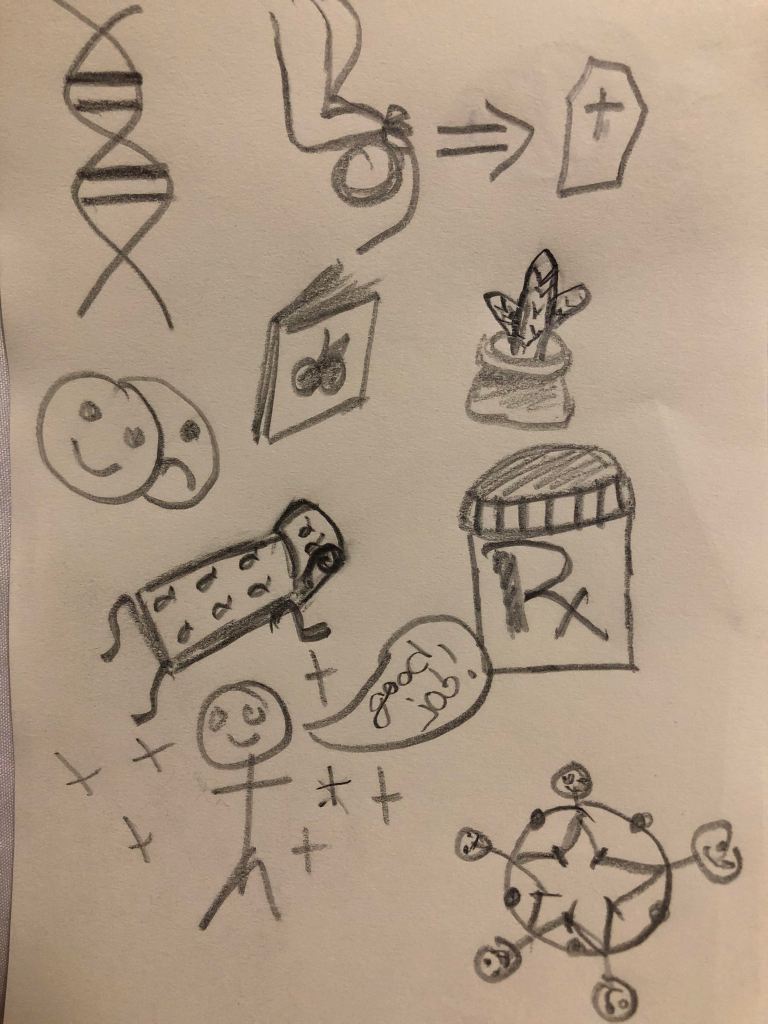
Here are a few doodled graphics to help remember the sub-fields of psychology!
Biological Psychology: they might study brain circuits that cause us to blush or sweat – or how heredity and experiences influence our individual differences in temperament
Developmental Psychology: they study our our changing abilities from “womb to tomb”
Cognitive Psychology (thought process): they study how our interpretation of a situation affects our anger and affects our thinking
Educational Psychology: they study influences on teaching and learning
Personality Psychology: they investigate our persistent traits
Social Psychology: they explore how we view and affect one another
Industrial-Organizational Psychology: they use psych methods and concepts in a work place to select and train workers, boost morale and productivity, design products, and implement systems
Human Factors Psychology: they focus on the interaction of people, machines, and physical environments
Counseling Psychology: they help people to cope with challenges and crises and to improve their personal and social functioning
Clinical Psychology: they assess and treat mental, emotional, and behavioral disorders
Positive Psychology: they explore positive emotions, positive character traits, and enabling in situations
Community Psychology: they create social and physical environments that are healthy for all
Now that you now the definitions, try going back to the photo above and matching the doodles to the corresponding sub-field! (Not all sub-fields have a corresponding doodle in the image above)
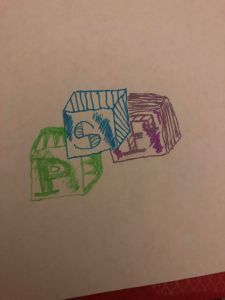
The building blocks of psych are the six schools of thought: structuralism, functionalism, psycho-dynamic, behaviorism, humanistic psych and cognitive neuroscience.
Everyone remembers playing with building blocks, so it can easily be related to every topic, like psych.
Structuralism
Structuralists were the first group of people to be interested in the mind enough to want to study it. The only problem was, where is the mind? Since it is not a physical thing, many people didn’t know where to start looking for it.
Fortunately, Wilhelm Wundt was curious enough to study the mind. He was a structuralist in 1879 and he built the first formal psychological laboratory. This laboratory let him try to find a starting place with analyzing the mind.
One of Wundt’s prominent students, Edward Titchener of 1892, gave structuralism it’s true shape. He wanted to identify the structure of the mind, hence the groups name.
Titchener used something called INTROSPECTION to try and identify the structure of the mind. Introspection is just asking someone to reflect on their own thoughts, feelings and perspectives.
While structuralism gave many psychologists a starting position to build from, this school of thought is rarely ever used now. This is because there is one huge issue with it: everyone has their own individual preferences.
Functionalism
After structuralists had their time in the spotlight, functionalists nudged them out of the way. They did so by introducing the theory that thinking, emotions and habits are adaptive.
One of the most famous functionalist was William James. James published a widely used textbook that explained many of his views. His main concept was that behavior helps us survive and thrive because we can learn to adapt to certain situations.
Although functionalism was the first scientific psychological school of thought, it also is rarely used today.
Psycho-dynamic/Psychoanalytic
The psycho-dynamic or psychoanalytic field is usually the first school of thought that people think about because it holds concepts for the classic psychologist-patient relationship. Yes, that’s right, sitting on a couch and droning on to a therapist came from psychoanalysis.
In the early 1900’s, Sigmund Freud – possibly the most well known figure in psych – developed psychoanalysis. It’s main focus was on what Freud liked to call the UNCONSCIOUS. He believed that unconscious mental forces direct our everyday behavior. Freud also said that we aren’t aware of our unconscious. Going along with his thinking, humans would not be able to have free will because the unconscious would be silently making all of their decisions.
The basis of Freud’s unconscious mental forces was that he believed a person’s psychological problems were directly resulted from unresolved, unconscious childhood conflicts. Basically, he believed that any issues a person had was because they were unconsciously battling a childhood trauma and they were unaware of it.
Some methods that Freud used to confront and treat the issues going on within a person’s unconscious were hypnotism, dream analysis and free association. Hypnosis is a heightened state of suggestibility, and Freud eventually backed away from this practice because he learned that the analyst could steer a patient. Instead, he heavily relied on dream analysis – or what he called the “royal road to the unconscious”- and the “talking cure.”
The talking cure, or free association, is just what it sounds like. A client relaxes and says anything that comes to mind. Hopefully the classic image of a patient laying on a couch pops up in your mind, because this is exactly what that practice is. To fully utilize this practice, the psychologists basically trace what a client says until they get to a little road block that causes the client to suddenly change topics. The psychologist then has to figure out why the unconscious steered itself away from that topic.
Behaviorism
The complete opposite of psychoanalysis, behaviorism was introduced by John Watson in the 1920’s. Watson argued that psychology should only study what could be observed and measured objectively.
Watson threw out the concept of the unconscious by focusing on studying OBSERVABLE behaviors. This is because he thought the unconscious was too subjective. B. F. Skinner contributed to this school of thought as well. He insisted that external influences, such as reward and punishment, shaped behavior.
Despite the incredible discoveries he made, John Watson was also criticized for his experiments. One specific experiment that caused controversy was his “Baby Albert” experiment where he trained a baby to be afraid of white animals.
As crazy as it sounds, Watson wanted to see if fear could be created. In order to do so, he introduced a baby with a white rat. Baby Albert grew close to the rat and loved playing with it until Watson started to play a loud sound whenever the rat came near him. The loud noise scared Baby Albert, so he then associated the noise with the white rat. After that, Watson took the sound away. Despite the lack of the scary noise, Albert’s fear remained. Even with a cute, fluffy white rabbit, Albert cried when it came near.
Unfortunately for Watson, Baby Albert was removed from the case study before he had a chance to untrain him of that fear, so Watson was criticized for letting the child grow up with a fear of white animals.
Humanistic Psychology
Years later, in the 1960’s, Carl Rogers and Abraham Maslow created humanistic psychology. The two focused on current environment and immediate experiences rather than Freud’s childhood and unconscious.
The hippie culture definitely influenced this school of thought, because they humanistic psychologists believe that all humans are capable of growth and reaching their potential. To put it simply, humanistic psych was all about self-concept.
In a quick self demonstration, if you hold one hand above the other and then level them out, that is what humanistic psychologists wanted to do. The top hand represented a person’s ideal version of them self, and the lower hand was their current self.
Humanistic psychologists would help clients to lower their goals to make them more realistic, and often times they would try to show the client that they were actually closer to their goal than they realized, bringing their current self closer to their ideal self.
Cognitive Neuroscience
Cognitive neuroscience is the last of the psychology schools of science. It is a lot different than most of the previous schools of thought because it refocused on mental processes.
The biggest difference with cognitive neuroscience is that it focused on mental processes with scientific studies of brain processes. Psychologists that specialize in cognitive neuroscience determine what parts of the brain are functioning for certain tasks.
Hello everyone! This is the first post of my new blog, so I’m still trying to figure everything out. Hopefully I can provide quality info and still make it interesting!
My blog is about psychology, so I will mainly be posting psych info that I learn in class, fun quotes I find and activities that go along with the topics.
 A Penny for Your Thoughts